5 Most Common Sales & Use Tax Exemptions
Written by Melisha Daniels, Managing ConsultantJuly 20, 2026
I can remember many moons ago, a time when business operations were conducted in Brick & Mortar stores. When state sponsored Sales & Use tax courses were complete because you only had to deal with your home state’s sales & use tax laws. A time when tax analysts could become proficient, almost an expert in the State & Local tax laws in which their perspective company had physical business operations.
The pre-company intranet days. When every blue moon, you'd get a phone call from someone asking about a Tax Exemption Certificate and you could answer with confidence "Why yes, I know about a Tax Exemption Certificate." You had a chance to research the tax law, the product being sold or purchased and its use, prior to accepting or providing a Tax Exemption Certificate. Ah, the good ‘ol days. We had electricity but not high-speed internet.
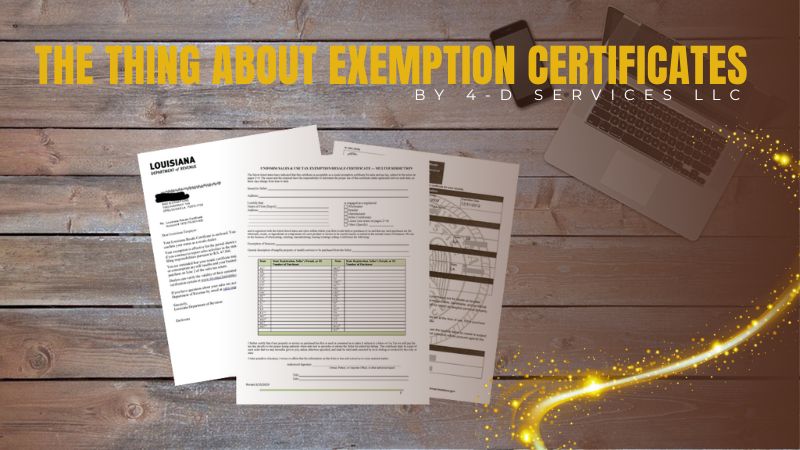
Albeit being thrust into the depths of economic nexus and Multi-State & Local tax legal variability, there remain some generalities that we can count on. Such as, Sales & Use tax being due on the sale, use or rental of tangible personal property and some services unless an exemption applies. And Sales & Use tax being imposed on the customer, purchaser or buyer of said property or services. With the responsibility of collecting remaining with the seller. And although each states' Sales & use tax law differs, we see these generalities extend to the type of Sales & Use tax exemptions.
The 5 Most Common Exemptions from Sales & Use Tax
Resale Exemption
The resale exemption is perhaps the most commonly claimed exemption. The sale for resale exemption allows businesses to purchase goods they intend to resell in their regular course of business without paying sales tax.
An example of the proper use of this exemption is the purchase of shirts by a clothing retailer from a wholesale supplier. The retailer will resell the shirts in their regular course of business. As the buyer, the clothing retailer will provide the seller, the wholesale supplier with a resale exemption certificate to waive the collection of sales tax on the invoice.
Manufacturing Exemption
Many of the taxable states and several territories, offer tax exemptions for equipment, machinery, and materials used directly in the manufacturing process. Allowing the buyer to purchase those goods without paying sales tax.
An example of the manufacturing exemption in use might be a bakery purchasing a new commercial oven used exclusively for baking goods for sale.
Depending on the state, this oven may be exempt from sales tax. As the manufacturing exemption can vary by state, the buyer should consult with the applicable states’ Administrative Tax code to verify the items they are purchasing qualify for the exemption.
Government Exemption
Sales to government entities are typically exempt from sales tax. This includes purchases made by public schools, universities, and other government entities.
An example of a purchase from a government entity might be a hospital purchasing TV screens for their waiting rooms. The purchase is exempt from sales tax. The hospital will provide an exemption certificate, exemption letter or other acceptable document to the buyer verifying they are indeed a government entity.
Charitable Organization Exemption
Many states provide sales tax exemptions to purchases made by qualified charitable organizations, such as nonprofits, churches and other religious institutions.
An example of a purchase made by a qualified charitable organization might be a homeless shelter purchasing food to provide meals for the people it houses.
If the organization is recognized as a 501(c )(3) organization by the IRS, this purchase is likely exempt from sales tax. The buyer will provide the substantiating documentation to the seller. And the sales tax will be waived on the transaction.
Industry Based Exemption
The Agricultural Exemption covers items used in agricultural production, such as farm equipment, seeds, fertilizer, and livestock. The goal is to support the agricultural industry.
An example of its use might be a farmer buying a tractor for use on their farm. This purchase is likely exempt from sales tax under the particular states’ agricultural exemption.
The Medical Exemption, according to a 2015 article published on Avalara.com, often covers the purchase of medical supplies meant to cure disease, prescribed medical equipment and some dental fees not covered by insurance.
Industry based exemptions vary from state to state. I highly suggest both parties, the Buyer and the Seller, staying up to date with the tax exemption laws relevant to the industry you operate in.
What Comes Next
The thing about Multi-State Tax Exemption Certificates is understanding the exemption type is only the first step in effective exemption certificate management. While the 5 exemption categories listed above are the most commonly claimed, the type of exemption claimed can determine which exemption certificate should be exchanged between the buyer and the seller.
For example, claiming a manufacturing exemption may require a state-specific manufacturing exemption certificate in one state. While another state may allow the purchaser to claim the same exemption using a general or multi-purpose exemption certificate.
Exemption eligibility requirements also vary from state to state. In as many as 12 U.S. states, a business must be properly registered before it can issue or accept certain exemption certificates. Both California and Florida require businesses to obtain some form of sales tax permit before they may issue, accept or otherwise administer exemptions in the state. Texas requires a business to hold a valid Sales & Use tax license before being eligible to take advantage of the states' sale for resale exemption.
These multi-state considerations highlight the complexity of managing exemption certificates across different jurisdictions. Making understanding the type of exemption only half the battle. Understanding the nuances of each state's exemption laws is crucial for effective compliance. And what ultimately protects the buyer and seller from paying tax on an otherwise exempt transaction.
Gone are the days of Brick & Mortar, the era of online sales and potential nexus in all 48 taxable states and several territories is upon us. Multi-State sales and economic nexus have become a mainstay in business operations for companies operating in America's post-pandemic society. This list is for those brave enough to tackle the task of Multi-State Tax Exemption Certificate administration in a post-Wayfair ruling era.